Stock code: 601677
Stock code: 601677
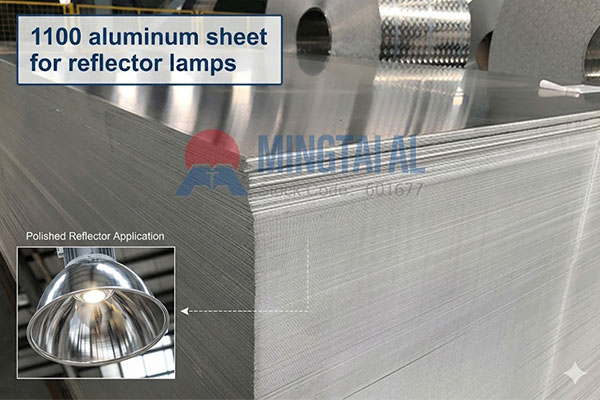
Anyone working with lighting knows that the reflector housing has a huge impact on lamp efficiency. If the aluminum sheet has low reflectivity, cracks during forming, or dulls over time, the whole fixture underperforms. That is why 1100 aluminum sheet for reflector lamps is one of the most widely used materials in this field. Below we explain why it works so well and how to choose the right one.
1100 aluminum is industrial pure aluminum with over 99.0% aluminum content. Several of its core properties are almost tailor‑made for reflector applications:
– High reflectivity – After polishing, 1100 aluminum sheet can reach a visible light reflectivity above 85%. That means less light waste, brighter lamps, and lower energy use.
– Fast heat dissipation – Reflector lamps generate heat, especially LED types. 1100 aluminum has a thermal conductivity around 222 W/(m·K). It pulls heat away from the light source quickly, extending the life of LEDs and drivers.
– Excellent formability – Reflector cups are often deep‑drawn into parabolic, conical, or multi‑curve shapes. 1100 aluminum sheet, especially in O‑temper (fully soft), can be stamped in one operation without cracking, making it ideal for high‑volume production.
– Good corrosion resistance – In indoor or sealed luminaires, the surface of 1100 aluminum stays bright for a long time without extra coating.
In real production, these types of lamps most often use 1100 aluminum for their reflective parts:
Not all 1100 aluminum sheets are the same. Pay attention to these factors when purchasing:
– Temper selection
– O‑temper (fully soft) – For deep‑drawn, complex reflector cups.
– H14 temper (half‑hard) – For flat reflectors or parts that need some rigidity.
– Thickness range
Common thicknesses are 0.3mm to 1.5mm. Small reflector cups (diameter < 50mm) can use about 0.4mm; large reflective surfaces or those with heat‑spreading function should be at least 1.0mm.
– Surface quality
The sheet must be free of scratches, oil stains, and corrosion spots – any tiny defect will be magnified in the reflection. Ask your supplier for a surface inspection report.
– Dimensional tolerance
Width, length, and diagonal tolerances must match the stamping die accuracy. ASTM B209 is the typical standard.
One more note: If you need a mirror finish, you can achieve it through mechanical polishing or film coating – we do not provide those services, but you can find local subcontractors who do.
Many customers ask: since 1050 and 1060 have higher purity, why not use them? Here is a quick comparison:
– vs 1050 – Similar purity, but 1100 contains a small amount of copper, giving slightly higher tensile strength (~110 MPa vs ~105 MPa). After stamping, the reflector holds its shape better with less springback.
– vs 1060 – 1060 is 99.6% pure but weaker. When the reflector needs to be self‑supporting or carry a light load, 1100 is the better choice.
– vs 3003 – 3003 is stronger but has lower reflectivity and costs significantly more. Unless the reflector also acts as the main heat sink, 3003 is rarely used.
Overall, 1100 offers the most balanced package for reflector lamps – good reflectivity, formability, strength, and cost.
Mingtai Aluminum supplies 1100 aluminum sheet for reflector lamps with flatness and elongation stability trusted by many lighting manufacturers worldwide. You can rely on it.
Q1: What is the maximum reflectivity of 1100 aluminum sheet for reflector lamps?
A: After mechanical polishing, it can reach 85–90%, depending on the polishing process and original surface quality.
Q2: If the sheet is too thin, will the reflector cup deform after stamping?
A: For cups under 50mm in diameter, 0.4mm is fine; for diameters over 100mm with no ribs, use at least 0.8mm.
Q3: Can 1100 aluminum sheet be directly welded to the lamp housing?
A: Yes, it has good brazing and gas welding performance, but TIG welding can be tricky – spot welding or riveting is recommended.
Q4: How can I tell if a sheet is suitable for reflector stamping when buying?
A: Ask the supplier for a tensile test report – elongation should be ≥20% (O‑temper) or ≥8% (H14 temper).
Q5: Does Mingtai Aluminum apply a protective film to its 1100 aluminum sheet?
A: Yes, we can apply PE film on request to prevent scratches during shipping and stamping.