Stock code: 601677
Stock code: 601677
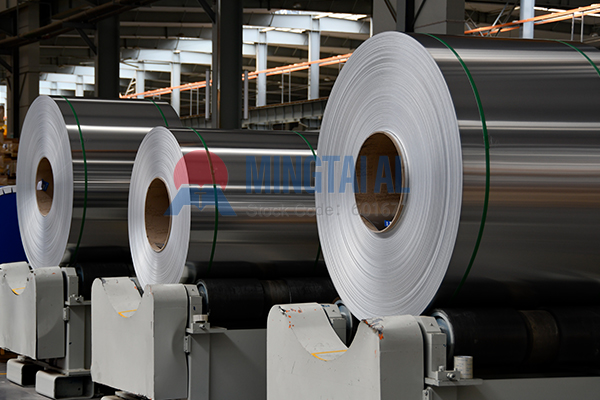
The performance of your color coating line depends heavily on the aluminum coil you feed into it. Selecting the right aluminum coil for color coating line is the first and most critical decision.
Many customers have found that problems like coating peeling, strip breakage, or roll scratches often come from the base coil itself – not the paint.
If you are sourcing aluminum coil for a coating line, make sure you understand these 7 key factors before placing an order.
Different alloys serve different applications. Picking the wrong one either wastes money or fails to meet performance needs.
– 1100 (pure aluminum) – Excellent formability, lowest cost. Suitable for ceilings, lighting fixtures, household appliances – light-duty building materials.
– 3003 (Al-Mn alloy) – Contains manganese. Good corrosion resistance, about 20% stronger than 1100.
This is the most widely used alloy for color coating lines, especially for roof panels, rolling doors, refrigerated truck bodies – products that need moderate stiffness.
– 5052 (Al-Mg alloy) – Higher strength, outstanding salt spray resistance. Ideal for coastal building facades, marine interiors – harsh environments. Price is higher accordingly.
> Quick summary: Choose 1100 coil for budget-sensitive projects, 3003 coil for general construction, and 5052 coil for severe conditions.
> By the way, 1060 pure aluminum and 3003 alloy are the two most popular options in terms of purchase volume.
Uneven coil thickness leads to uneven coating thickness.
On high-speed coating lines (often over 80 m/min), thickness variations cause unstable coating roller pressure. The result: some areas get too much coating, others too little. In severe cases, color differences appear across the whole coil.
Industry standards require tight thickness control. For thin coils of 0.2–0.5mm:
– Basic requirement: ±0.02mm (for normal needs)
– Recommended for high-end or high-speed lines: ±0.005mm (5 microns) – this ensures consistent coating thickness across the entire strip.
This factor is often overlooked, but the consequences are serious.
After rolling, aluminum coils carry residual rolling oil and aluminum powder. If not thoroughly removed, the subsequent chemical pretreatment (chromating or passivation) cannot bond properly. The result: coating blistering, peeling, and a major drop in yield.
> When purchasing, always ask for the surface cleanliness test report – do not rely on verbal promises.
Waves, edge waves, and buckles – these “shape defects” are hidden killers on a coating line.
If the coil is not flat, it vibrates at high speed, scratching the coating roller or doctor blade. Meanwhile, coating thickness fluctuates, increasing scrap rates dramatically.
For aluminum coil used on a color coating line, flatness requirements are:
– Lateral flatness over 2m length: ≤5 I-units
– Longitudinal wave height per meter: ≤2mm
Tension leveling is the key process to improve shape. Make sure your supplier uses this step.
A coating line includes multiple stages: entry accumulator stretching, curing oven, water quenching, and several bending passes. The coil’s elongation and tensile strength must be adequate.
If the coil is too brittle (elongation below 5%), it may crack on the bending rollers. Here are recommended values for common alloys:
|
Alloy/Temper |
Tensile Strength (MPa) |
Elongation (≥) |
|
3003-H14 |
90 – 130 |
10% |
|
5052-H34 |
170 – 220 |
12% |
> For 3003-H14, minimum 10% elongation is recommended, not 5% – this distinguishes it from ordinary aluminum coil.
Inaccurate width leads to misaligned coating edges. Too much burr scratches the coating roller.
Specific requirements:
– Width tolerance: suggest ±1.0mm
– Burr height: ≤ 0.05mm
– Inner diameter: common sizes 508mm or 505mm. Avoid oval or undersized IDs – they make loading difficult.
Changeover time is production time. Wrong ID wastes a lot of man-hours.
Once the coil surface is corroded or damaged on arrival, it is directly scrapped.
A reliable packaging solution includes at least:
– Multi-layer wrapping: moisture-proof paper + plastic film + VCI rust-proof paper
– Edge protectors
– Wooden bottom frame (grid type) to prevent impact damage
These measures prevent dents and edge cracks – because once such defects exist, the coil cannot run on the coating line at all.
– Correct alloy? 1100 / 3003 / 5052 as per application
– Tight thickness tolerance? ±0.005mm recommended for high-speed lines
– Low residual oil? Require <5 mg/m² and ask for test report
– Flat shape? Flatness ≤5 I-units
– Adequate elongation? For 3003, ≥10%
– Width / ID match your line? Width tolerance ±1mm
– Proper packaging? Multi-layer wrapping + edge protection
Once all 7 items are confirmed, your coating line’s yield and stability are well secured.
For a smooth and efficient color coating process, choose Mingtai Aluminum for your aluminum coil needs. We supply coils with low residual oil, precise tolerances, and consistent mechanical properties – the reliable base material for your color coating line.
Q1: What is the most common aluminum alloy for color coating line?
A1: 3003 is most common – it offers good strength and formability for building panels.
Q2: How does surface residual oil affect color coating?
A2: Excess oil prevents chemical pretreatment from bonding, causing peeling, blistering, or pinholes.
Q3: Can I use ordinary aluminum coil directly on a color coating line?
A3: No – ordinary coil has too much residual oil and requires thorough degreasing before coating.
Q4: What thickness tolerance is recommended for high-speed coating lines?
A4: ±0.005mm (5 microns) is recommended to ensure uniform coating thickness.
Q5: Why is coil flatness so important for color coating?
A5: Poor flatness causes uneven coating application and may scratch the coating roller.