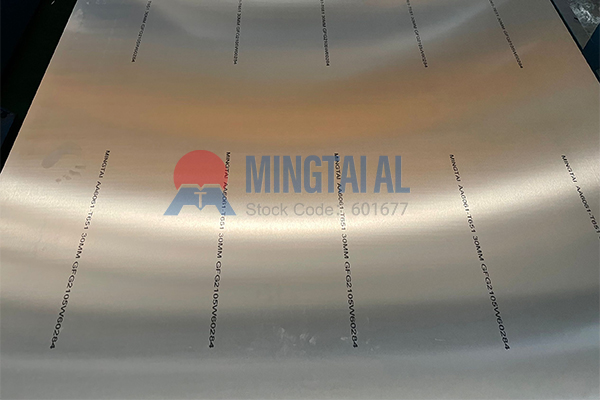
Stock code: 601677
Stock code: 601677
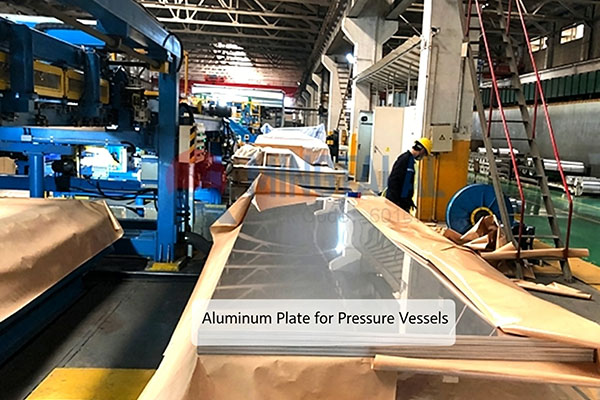
Choosing the right aluminum plate for pressure vessels is not just about thickness and price. Pressure vessels demand strict performance in pressure resistance, weldability, corrosion resistance, and safety margins. A wrong choice can lead to early equipment failure or even accidents. Follow these five key steps to make a fast, sound decision.
Any aluminum plate used for pressure vessels must meet a recognized material standard. In North America and many global markets, ASTM B209 is the basic reference. It specifies chemical composition, mechanical properties, dimensional tolerances, and testing methods.
Common customer question: “What should I see on a material certificate?”
Answer: The certificate must clearly list the standard (e.g., ASTM B209), alloy grade, temper, lot number, and all measured values. Never accept a plate without a complete, traceable mill test certificate.
> Note: Different regions may use equivalent standards (EN 485, GB/T 3880). Check your project requirements before purchasing.
The most common aluminum alloys for pressure vessels are 5083 and 6061. They have different strengths.
– Alloy 5083
– Non-heat-treatable, excellent weldability.
– Very good resistance to seawater and chemical corrosion.
– Retains toughness at low temperatures – ideal for LNG tanks, chemical carriers, and medium/low-pressure vessels.
– Common tempers: O (annealed, very soft), H112 (suitable for forming and then use).
– Alloy 6061
– Heat-treatable, higher strength than 5083.
– Good weldability, but the welded zone loses some strength.
– Better for clean, mild environments that still require high pressure capability – e.g., air receivers, hydraulic tanks.
– Common temper: T6 (solution treated + artificial aging).
– Other options : 5454 (slightly better high-temperature resistance), 5754 (medium strength).
Quick conclusion: If the vessel contacts corrosive media or operates at low temperature, choose 5083. If strength is the main need and the environment is clean, 6061-T6 is more economical.
Ask your supplier for a tensile test report at both room temperature and the design temperature. Focus on three values:
– Yield strength – Determines how much pressure the vessel can withstand without permanent deformation. For example, 5083-O yields ~125 MPa, while 5083-H112 yields ~170 MPa.
– Tensile strength – A safety margin. Usually required to be at least 1.5 times the yield strength.
– Elongation – Affects forming processes like head stamping and rolling. For pressure vessel plates, elongation should generally be ≥10%.
For low-temperature service (e.g., -196°C), also confirm Charpy impact values. At such temperatures, 5083 has much higher impact toughness than 6061.
Many selection mistakes come from dimensional tolerances.
– Thickness range : Typically 6–50 mm. Over 50 mm requires special rolling.
– Width : Choose wider plates to reduce the number of welds. Some pressure vessel plates can be as wide as 2500 mm or more.
– Thickness tolerance : ASTM B209 general tolerances are acceptable, but for deep‑stamped heads, agree on “pressure vessel grade tolerance” (e.g., within ±0.2 mm) with your supplier.
– Flatness : Measure flatness before welding. It should not exceed 3 mm per meter; otherwise, welding distortion will be high.
Practical tip: Write thickness tolerance and flatness requirements into your purchase agreement. Spot-check incoming plates with a feeler gauge and straight edge.
Even if the standard, alloy, and dimensions are correct, an unstable production process can still give you plates with internal porosity, laminations, or inclusions.
You should ask the supplier for at least the following:
– ISO 9001 quality certificate
– Ultrasonic test report for each plate or each batch (ASTM B209 requires ultrasonic inspection for pressure vessel use)
– Complete traceability records: from ingot number to final plate lot number
> Avoid a common mistake: do not use ordinary industrial aluminum plates for pressure vessels. The latter must have an ultrasonic test report – the difference directly affects weld safety and pressure integrity.
– Applicable standard (ASTM B209 or equivalent)
– Alloy: 5083 (corrosion/low temperature) or 6061-T6 (high strength/clean environments)
– Yield, tensile, and elongation meet design pressure and temperature
– Thickness/width/tolerances suit your forming process
– Supplier provides ultrasonic test report, mill certificate, and traceability records
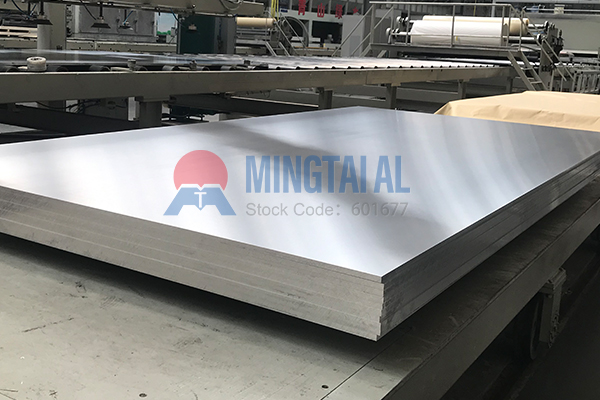
When you need stable, compliant aluminum plate for pressure vessels, Mingtai Aluminum offers ASTM B209-compliant plates in 5083, 6061, and other grades, with custom sizes and complete traceable documentation.
Q1: Which aluminum alloy is most common for pressure vessels?
A1: Alloy 5083, due to its excellent weldability and corrosion resistance.
Q2: Is ASTM B209 enough as the only standard?
A2: Yes for projects following ASTM rules, but you must also request an ultrasonic test report.
Q3: What is the difference between 5083-O and 5083-H112?
A3: O temper is softest for complex forming; H112 temper is stronger and can be used directly for shells.
Q4: Can thickness tolerance be as tight as ±0.1 mm?
A4: Standard ASTM tolerance for heavy plates is about ±0.2–0.3 mm. Tighter tolerances require a special agreement with the supplier.
Q5: Does the article cover surface treatment of the plate?
A5: No – this article focuses on selecting the bare plate. Surface treatment is a separate step if needed.