Stock code: 601677
Stock code: 601677
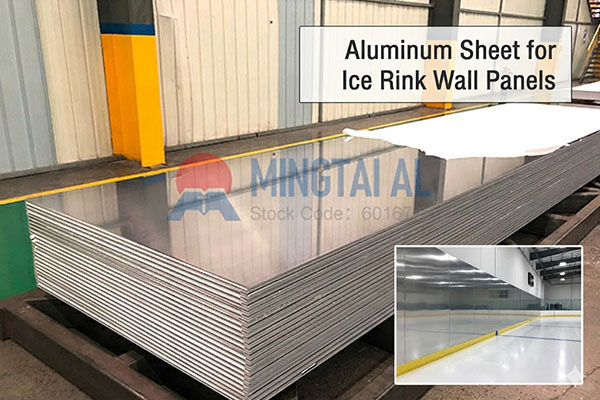
Aluminum Sheet for Ice Rink Wall Panels must withstand freezing temperatures, skate blade impacts, and constant humidity. Many builders focus only on price and appearance, but the real key is low-temperature performance. Ordinary aluminum can become brittle at -20°C or lower, while the right alloy keeps your wall panels safe for years.
So how do you choose the right aluminum sheet for an ice rink? The most common questions all point to the same technical standards.
An ice rink is not a regular cold room. Wall panels face not only low temperatures but also high-speed puck impacts, accidental skater collisions, and moisture from melted ice. A good low-temp aluminum sheet should have:
– Brittleness resistance – certain alloys stay ductile at -40°C, they won’t crack on impact.
– Impact strength – high enough yield strength so dents don’t turn into breaks.
– Corrosion resistance – ice rinks have 80%+ humidity; aluminum’s natural oxide layer prevents rust without extra coating.
– Dimensional stability – low thermal expansion keeps large panels from pulling apart at joints.
One common question: “Will aluminum crack at -30°C?” Simple answer – cheap, low-grade alloys will, but low-temp alloys won’t.
Alloy: Choose 5xxx Series (Magnesium)
For ice rink walls, go with 5052, 5083, or 5754. These aluminum-magnesium alloys actually become tougher at low temperatures (compared to room temperature). They are the industry standard.
– 5052 – best value, works for most rink barriers and crash walls.
– 5083 – higher impact resistance, ideal for pro hockey rinks and speed skating.
– 5754 – slightly better corrosion resistance than 5052, good for underground rinks with extreme humidity.
Avoid 2xxx (aluminum-copper) and 7xxx (aluminum-zinc) alloys. They risk stress corrosion cracking at low temperatures, and cracks are very hard to repair.
Temper: H32 or H34 – Never H18
– H32 – strain-hardened and stabilized, keeps stable dimensions and good toughness at low temps.
– H34 – slightly stronger than H32, for high-impact areas.
– H18 (full hard) – becomes brittle at low temperatures. One skate blade hit can crack it. Never use this for ice rinks.
Thickness: 1.5mm to 3.0mm by zone
– Regular spectator barriers: 1.5mm is enough.
– Player entry areas, behind goals: use 2.5mm or 3.0mm.
– Full wall panels: usually 2.0mm – good balance of strength and weight.
Many people search for “large size aluminum sheet to reduce joints”. Rink wall heights are typically 1.2m to 2.4m. Mingtai supplies coils and cut-to-length sheets up to 2.5m wide – fewer joints means fewer leak points.
Builders often compare materials. Here is the direct comparison:
– vs plastic/composite – plastic gets hard and brittle in cold, skate blades cut through it easily, and it ages fast. Aluminum resists impacts, doesn’t age, and is recyclable.
– vs stainless steel – stainless is strong but heavy and costs twice as much. Installation takes longer. Aluminum weighs one third of stainless, goes up faster, and in high-humidity rinks stainless can still pit while aluminum’s oxide film is actually more stable.
– vs coated panels – some ask “do I need a fluorocarbon coating?” For rink walls, no. The natural oxide film on aluminum already prevents rust and moisture damage. Coating adds cost and is hard to repair once scratched.
“Will aluminum crack at -40°C?”
No. 5052-H32 has impact strength above 30J at -50°C and higher. It has no ductile-to-brittle transition.
“How thick for hockey puck impacts?”
2.0mm works for amateur games. For pro rinks, use 2.5mm or more.
“What about condensation on the surface?”
Aluminum doesn’t absorb water. Condensation runs down the panel and drains away if you leave small holes at the bottom. No rust.
“Do I need expansion joints during installation?”
Yes. Leave one expansion joint every 6–8 meters. Use elastic gaskets behind fasteners. The panel won’t crack from thermal movement.
“Can I save money with the cheapest aluminum sheet?”
1100 or 3003 alloy is cheaper, but its low-temperature toughness is poor. If a panel cracks and forces your rink to close, the loss will be far greater than the material savings.
The right Aluminum Sheet for Ice Rink Wall Panels = 5xxx alloy (5052/5083) + H32/H34 temper + 2.0–3.0mm thickness. No coating needed, no complex fabrication. Choosing the right grade is the safest and most cost-effective way.
Mingtai Aluminum supplies stable low-temperature aluminum sheet with proven cryogenic toughness – ready for your ice rink project.
Q: What is the lowest temperature for ice rink aluminum sheets?
A: 5052-H32 aluminum is safe down to -50°C.
Q: Do I need extra anti-corrosion coating?
A: No. The natural oxide layer on aluminum is enough for ice rink humidity.
Q: Will panel joints shrink and leak at low temperatures?
A: Use pre-drilled holes with elastic gaskets and one expansion joint every 8m – no problem.
Q: How is Mingtai’s low-temperature impact performance?
A: Mingtai 5xxx low-temp panels have impact strength >30J at -40°C – no brittle failure risk.