Stock code: 601677
Stock code: 601677
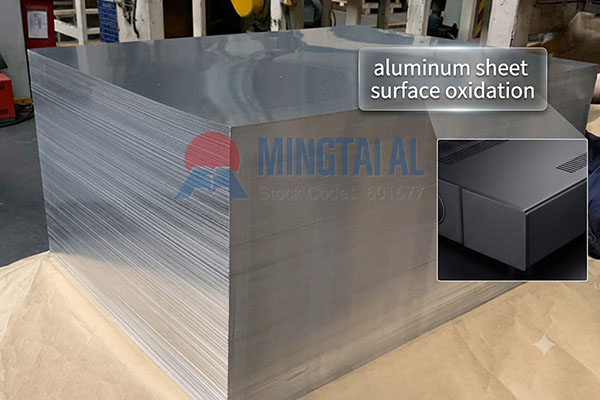
Many buyers receive brand‑new aluminum sheets, store them for a few weeks, and then find dark stains or white powder on the surface. Their first thought is often “bad quality.” In reality, when aluminum sheet surface oxidation becomes visible and abnormal during storage, the root cause is almost never a material defect – it’s nearly always the environment and how you store the sheets.
The natural oxide film that forms on aluminum in air is only a few nanometers thick, transparent, and actually protective. The “oxidation” customers complain about is usually white rust, black spots, pitting, or chalking – which are corrosion phenomena. And corrosion always has a trigger. Let’s look at the five most common triggers.
When the storage relative humidity stays above 80% for a long time, a microscopic water film forms on the aluminum surface. That film, together with oxygen and trace impurities, starts electrochemical corrosion.
Even sneakier is condensation. During the day the warehouse warms up, but the metal surface stays cooler. In the evening when temperatures drop, moisture in the air condenses directly onto the sheets as tiny droplets. Between stacked sheets, or between a sheet and a wooden pallet, those droplets get trapped – and within days you see white or black corrosion spots.
Keep humidity below 60% – that single step cuts most condensation risks.
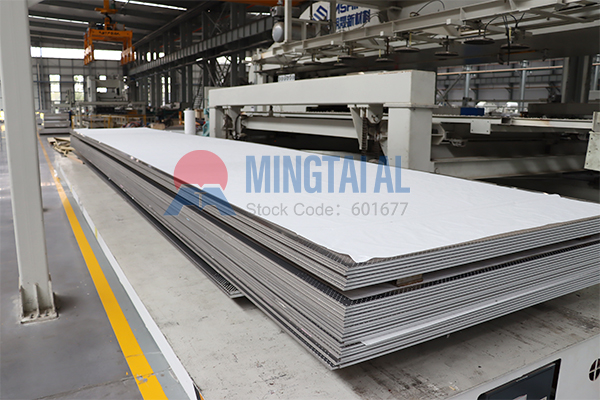
Factory‑fresh aluminum sheets are usually sealed with PE moisture‑proof film, vapor‑corrosion‑inhibitor (VCI) paper, and desiccants. Intact, that packaging can protect for months. But once the customer opens the pack for inspection, cuts a sample, or the packaging gets torn during transport, the situation changes:
– Humidity enters through the damage, but cannot easily escape – you create a “high‑humidity greenhouse” inside the wrap.
– Some people re‑wrap with ordinary plastic tarps. Any moisture already inside has nowhere to go, so corrosion actually speeds up.
– Wooden pallets with high water content (fresh wood >20% moisture) send humidity upward, breaking the sealed environment from below.
Practical tip: If you open a pack and don’t use all sheets immediately, reseal it with moisture‑proof film and fresh desiccant. Note the opening date on the package.
This problem is very common during container shipping or in seasons with large day‑night temperature differences.
During the day, air inside the packaging expands and “exhales” through tiny gaps. At night, the air contracts and “inhales” humid outside air. With each breath, the internal humidity slowly rises to match the damp exterior.
If you notice that sheets stored near an outer wall, a window, or a doorway oxidize more than those deep inside the warehouse – temperature swings and breathing are very likely the cause.
The natural oxide layer on aluminum is stable in a pH range of roughly 4 to 9. Once it contacts any of the following substances, the layer breaks down:
– Acids – acetic acid from fresh wood pallets, acid residues from cleaning, or sulfur dioxide in industrial exhaust.
– Alkalis – moisture wicking up from a concrete floor (concrete is alkaline), lime dust.
– Salts – sea mist in coastal warehouses, de‑icing salt residues.
– Fingerprints – chlorides and lactic acid in sweat. A single fingerprint can turn black after one week.
> Alloy recommendation: For storage environments that are hard to fully control, consider alloys with better corrosion resistance – for example 5xxx series (5052) or 6xxx series (6061). See [internal link for alloy selection].
Storing aluminum sheets directly on a concrete floor is a big mistake – concrete releases moisture from below and is alkaline. When you stack many layers, the bottom sheets face both pressure and trapped dampness, and the contact surface oxidizes first.
A more hidden trap is contact with dissimilar metals. When aluminum touches iron, steel, copper, or stainless steel in a humid environment, galvanic corrosion occurs: aluminum becomes the anode and corrodes much faster. Common errors include:
– Using iron blocks or steel pipes as separators between sheets.
– Storing aluminum sheets next to copper tubes or galvanized parts.
– Leaving iron or copper dust on the warehouse floor.
Correct method: Keep sheets at least 10 cm away from floors and walls. Use dry solid‑wood or plastic pallets. Separate layers with clean corrugated cardboard or dry wooden strips.
– Keep warehouse humidity at 40%–60% and temperature as stable as possible (avoid daily swings >10°C).
– Keep original packaging intact. After opening, reseal with moisture barrier + desiccant.
– Store off the floor and off the wall. Use dry pallets. Avoid storing near acids, alkalis, salts, or fertilizer.
– Inspect regularly. If you see condensation, wipe it dry immediately and improve ventilation.
– Store different metals in separate zones – never let them touch directly.
Abnormal aluminum sheet surface oxidation during storage is not a default verdict of “poor quality.” It is an engineering problem that can be solved with proper environmental control. Keep humidity low, prevent condensation, protect the packaging, avoid contaminants and dissimilar metals – most customers can store aluminum sheets for 6 to 12 months with a clean, intact surface.
Q1: Are the white spots on my aluminum sheet mold?
A: No, that’s white rust – a corrosion product caused by high humidity or condensation.
Q2: Can I just cover my aluminum with regular plastic tarp to prevent oxidation?
A: No – plastic tarps trap moisture inside and actually speed up corrosion.
Q3: Why are some sheets on the same pallet oxidized while others look fine?
A: Usually because different gaps between stacked sheets hold different amounts of moisture.
Q4: Can I still use slightly oxidized aluminum sheets?
A: White rust can be removed with fine sandpaper or chemical cleaning, but pitting will affect further processing.
Q5: How do I prevent oxidation during ocean shipping?
A: Use VCI paper plus aluminum‑composite vacuum packaging and enough desiccant.
Mingtai Aluminum supplies stable and clean aluminum sheets – proper storage keeps that quality from our factory to your workshop.