Stock code: 601677
Stock code: 601677
Selecting the right embossed aluminum sheet for your project can be challenging given the variety of patterns, alloys, and thicknesses. This guide focuses on three practical aspects: which pattern solves which problem, how embossing improves structural performance, and the six key parameters to clarify before ordering.
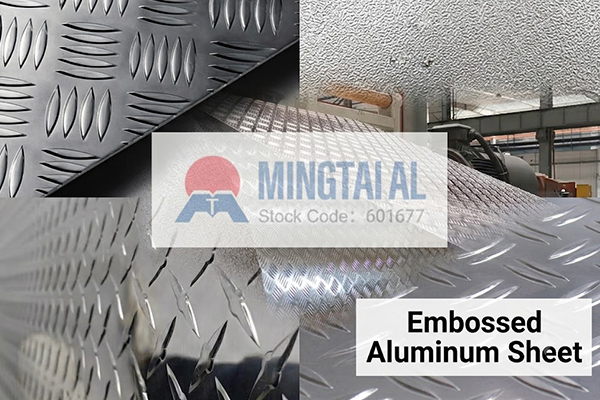
Every embossed texture is designed with a specific purpose. Before choosing a pattern, clarify your primary need—slip resistance, stain concealment, or enhanced rigidity.
|
Pattern Type |
Core Function |
How It Works |
Recommended Uses |
|
Stucco / Orange Peel |
Hides scratches & reduces glare |
Fine granular surface masks minor marks and diffuses light |
Refrigerator liners, HVAC panels, decorative surfaces |
|
Diamond |
Bidirectional slip resistance & high stiffness |
Raised diamonds create multidirectional grip and act as micro‑supports for bending strength |
Industrial flooring, truck decking, walkways |
|
Five‑Bar |
Directional grip & easy cleaning |
Parallel raised bars provide one‑way traction; open channels simplify washing |
Loading ramps, sloped walkways, food‑processing floors |
For foot‑traffic areas, diamond or five‑bar patterns work best. For refrigeration interiors, stucco is more practical. If visual quality matters most, hammer finishes offer a premium look.
Many see embossing only as a surface treatment, but it also adds structural benefit. The raised patterns act like thousands of miniature stiffening ribs across the sheet. As a result, an embossed aluminum sheet of a given thickness offers greater bending stiffness than a plain sheet of the same gauge. Conversely, you can use a thinner embossed sheet to replace a thicker plain sheet—saving material weight and cost while maintaining performance.
However, the stiffening effect varies by pattern. Five‑bar delivers more reinforcement along the bar direction, while diamond patterns perform well in both directions. Knowing the load direction in your application helps you avoid over‑engineering.
Incomplete specifications often lead to back‑and‑forth and mismatched quotes. Having these six details ready makes communication with suppliers smooth and precise.
With this checklist, you can get accurate quotes faster and avoid repeated clarifications.
Even experienced users may hold some misconceptions. Here are a few worth noting:
– Deeper patterns are always better.
Not necessarily. Over‑deep embossing reduces the effective load‑bearing cross‑section and may weaken local strength. Balance depth with actual structural demands.
– All patterns provide the same rigidity improvement.
No. Diamond patterns outperform one‑way patterns like five‑bar in bidirectional bending resistance. Consider load direction when selecting.
– Embossed surfaces are scratch‑proof.
Texture can hide minor marks, but heavy impacts during transport still cause visible damage. Inspection upon delivery remains important.
– The same pattern performs identically on all thicknesses.
Thin sheets cannot take deep embossing without risk of deformation or cracking, while shallow patterns on thick sheets may look barely visible. Match depth to sheet thickness.
– Embossed sheet bends and punches just like plain sheet.
Not directly. Bending and punching require adjusted tooling and pressure settings, otherwise spring‑back or edge cracking may occur. Always run a trial before full production.
Ultimately, choosing the right material comes down to three simple questions: *What surface function does your application need? What structural stiffness is actually required? And can you clearly specify all parameters?* Answer these, and your choice becomes straightforward.
Quality is not about paying more or picking the most complex pattern—it is about finding the best match for your real‑world working conditions. Use this guide to make your next selection more confident and accurate.
Mingtai Aluminum offers a wide range of aluminum sheet and coil products in multiple alloys and specifications, backed by stable supply and professional service to support your project success.
Q1: Which pattern provides the highest slip resistance?
Diamond offers the best multidirectional grip, while five‑bar is suitable for one‑way traffic and frequent washing.
Q2: Can embossing really let me use a thinner sheet without losing strength?
Yes—the micro‑stiffeners from embossing improve bending stiffness, so a thinner embossed sheet can match a thicker plain sheet.
Q3: What specification is most often overlooked?
Thickness clarity—always state whether you mean base or finished thickness, as they differ significantly.