Stock code: 601677
Stock code: 601677
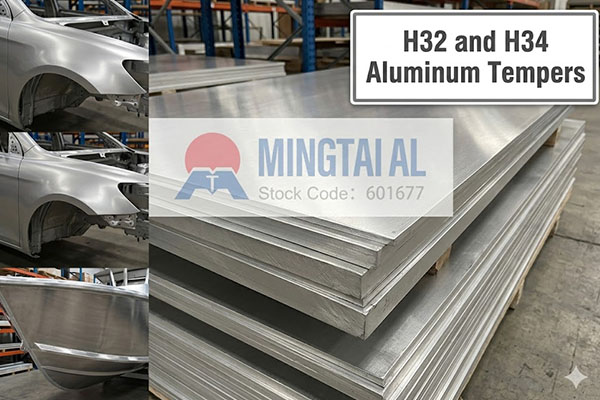
When selecting aluminum sheet, two tempers often cause confusion: H32 and H34 Aluminum Tempers. Both belong to the work-hardened series, yet they serve very different needs. Choosing the wrong one can lead to cracking during bending or premature deformation under load.
The key takeaway is simple: H34 is harder and stronger than H32, but it sacrifices some formability.
H32 and H34 are made by cold working followed by a stabilising treatment. The only variable is how much cold work is applied.
– H32 is roughly “quarter-hard” – less cold work, moderate strength.
– H34 is roughly “half-hard” – more cold work, higher strength.
Both are stabilised, so they resist stress corrosion and won’t soften over time. Important note: neither is heat-treated; they get their strength from being rolled harder.
|
Property |
H32 |
H34 |
|
Tensile strength (MPa) |
210–260 |
250–310 |
|
Yield strength (MPa) |
≥165 |
≥215 |
|
Elongation (%) |
12–16 |
8–12 |
|
Typical hardness (HB) |
~60 |
~68–72 |
H34 offers about 20% higher tensile and yield strength, but its elongation drops by one third. That means H34 is less ductile – it won’t stretch as far before breaking.
– Bending: H32 can manage a 0.5× thickness inner radius for a 90° bend without cracking. H34 needs 1–2× thickness – a tighter radius often causes micro-cracks.
– Drawing / stamping: H32 works well for medium-depth stampings (e.g., tank ends, enclosures). H34 is only suitable for shallow draws; deeper parts may tear.
– Cutting & drilling: H34’s higher hardness reduces gumming, giving a slightly better finish. H32 is also fine but may require better chip clearance.
– Welding: Both weld similarly. The heat‑affected zone loses 20–30% of strength, but H34’s base metal stays stronger.
Pick H32 when your part involves bending, flanging, rolling, or any significant forming.
– Water tank shells and end caps
– Ship bulwarks and outboard brackets
– Automotive interior panels and dash brackets
– General sheet metal enclosures and control cabinets
Don’t worry about strength – H32’s yield strength exceeds 165 MPa, enough for most moderately loaded structures.
Choose H34 if the part mainly bears heavy pressure, abrasion, or requires higher load capacity.
– Truck floor panels and anti‑skid tread plates (resists deformation under heavy loads)
– Ship structural members like frames and stringers (higher strength required)
– Pressure vessel shells (where yield strength must meet a minimum)
– Parts that resist scratching (harder surface wears better)
Also, for the same strength requirement, H34 allows a thinner gauge – saving weight and cost.
> “Need formability? Pick H32. Need strength? Pick H34.”
If your bend radius is less than the sheet thickness, go H32. If the part is nearly flat and only sees uniform pressure or wear, H34 offers better value.
Never swap them arbitrarily. Using H34 as a high-strength H32 will punish your tooling. Using H32 in place of H34 may lead to premature failure.
When you need a reliable supply of H32 and H34 Aluminum Tempers, Mingtai Aluminum provides mill test reports with full traceability – helping you match the right temper to your actual forming process.
Q: Which is harder, H32 or H34?
A: H34 is harder – roughly half-hard versus quarter-hard for H32.
Q: Is H34 more likely to crack during bending?
A: Yes, it needs a larger bend radius (1.5× thickness or more) compared to H32.
Q: Do they weld the same?
A: Very similarly. Both weld well, and both lose about 20–30% of strength in the heat‑affected zone.
Q: Can I replace H32 with H34 to get higher strength?
A: Not recommended unless you re‑validate bending, stamping, or other forming steps.
Q: What’s the simplest way to decide which to use?
A: Check if your part needs complex bending – if yes, choose H32; if no, choose H34.